Most investors check the grey market premium in isolation and treat a high number as a reason to apply. That is a shortcut with real risks. GMP is an unofficial, dealer-driven sentiment number, not a forecast. It tells you how the informal market feels about an issue today, but nothing about dates, price band, lot size or whether you can still apply.
The structure comes from the official-shaped details: opening and closing dates, issue size, price band and status. This article shows how to read the live IPO GMP tracker on MalikTimes alongside the Mainboard IPO 2026 list, so sentiment is always checked against structure before you commit money.
What the IPO GMP Page Actually Shows You
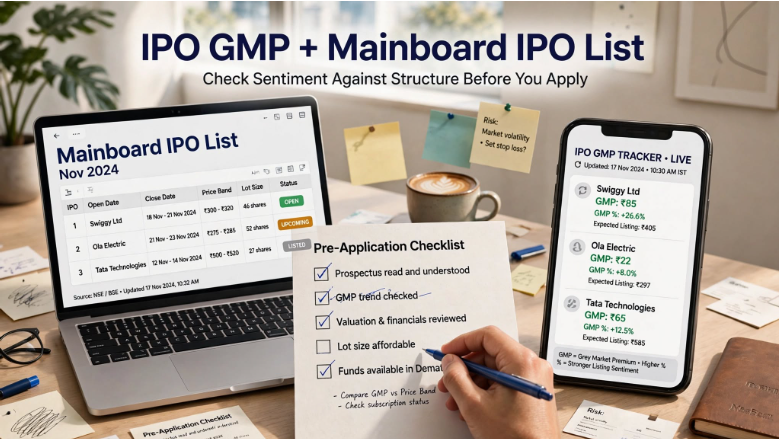
The GMP page tracks IPOs that are open, upcoming or recently closed. For each one, you will typically see:
- GMP in rupees and GMP %
- IPO price (issue price)
- Expected listing price and listing gain
- Lot size
- Open and close dates and the listing date
- Status: Open, Upcoming or Listing
The page also carries the Kostak rate and Subject to Sauda. These are different from GMP and are often confused with it. You can see all of this at the tracker here:
How to read expected listing price and listing gain
The arithmetic is simple. Expected listing price = issue price + GMP, and listing gain % = GMP ÷ issue price × 100. For example, with an issue price of ₹200 and a GMP of ₹20, the expected listing price is ₹220 and the indicated gain is 10%. If the lot is 75 shares, that is roughly ₹1,500 per lot on paper, before charges and taxes, and only if you are allotted shares. These numbers are illustrative.
What the status column tells you
- Open: the bidding window is live, so you can still apply.
- Upcoming: dates are announced but bidding has not started.
- Listing: the application window has closed, so a premium you see is no longer actionable for applying.
Why GMP moves daily
GMP reflects shifting demand and supply in an informal market. It responds to subscription numbers, market mood and news, so a figure you noticed on Monday may not hold by Friday. Always check the date and status beside any number.
The page itself repeats an important caution: GMP is informal, sits outside the exchanges and is driven by demand and supply. A high GMP does not guarantee a good listing.
What the Mainboard IPO Page Adds That GMP Cannot
If GMP is the mood, the Mainboard IPO 2026 page is the structure. It lists each IPO’s name, opening and closing dates, issue size and price band in one place, and separates issues into Upcoming, Open and Recently Listed, which is the sequence an investor needs to plan around.
It also works as a hub, linking to the GMP page, subscription status, allotment status and listing-day trackers. You can open it directly here:
Three ways to use it:
- Use the calendar section to avoid missing a closing date.
- Use the Recently Listed section to compare past GMP estimates with actual listing outcomes. This is a useful reality check on how far grey market numbers can drift.
- Use the Subscription Status link to see whether demand is broad-based or concentrated in one investor category.
Like the GMP page, it stresses that GMP is not an official indicator and should be read alongside business quality, financials, valuation and management.
How to Combine the Two Pages Into One Workflow
Here is a simple four-step routine.
Step 1: Screen on the Mainboard IPO page. Open the list and filter to issues that are Open or Upcoming. Note the price band, lot size and closing date for each. This is your application logistics.
Step 2: Check GMP on the tracker. For each shortlisted issue, read the current GMP, GMP % and expected listing price. Compare the GMP % across issues, because a 2 to 3% premium and a 20 to 30% premium are very different signals.
Step 3: Cross-check subscription and demand. Use the subscription status link from the Mainboard page. A high GMP with weak QIB (qualified institutional buyer) subscription tells a different story from a high GMP backed by strong institutional demand. The status column on the GMP page also helps you avoid chasing a number for an issue that is no longer open.
Step 4: Read GMP as sentiment, not a price target. The figure is unofficial and can differ sharply from the actual listing. Use the Recently Listed section for examples where estimates and outcomes did not match. Your final decision should combine business fundamentals, valuation, subscription demand and GMP as just one input.
The Mistakes Both Pages Are Trying to Prevent
- Chasing a single GMP number without checking dates. The Mainboard page shows whether an issue is still open, while the GMP number for a closed issue may be stale.
- Confusing Kostak with GMP. Kostak is a payment for the application itself, not the premium on the shares.
- Assuming a high GMP means a good company. GMP is sentiment, not quality.
- Ignoring lot size and price band. The Mainboard page gives the real cash outlay, while the GMP page gives the expected gain on that outlay. You need both to judge risk and reward.
- Applying to everything because the calendar looks busy. The Mainboard page shows how many issues overlap in a week, and the GMP page shows which ones the grey market is excited about. Neither is a reason to apply on its own.
A Quick Checklist Before You Apply
- □ I checked the Mainboard IPO list for opening and closing dates and the price band.
- □ I checked the GMP page for the current premium and expected listing price.
- □ I checked subscription status by investor category.
- □ I read the risk factors and financials in the RHP, not just the GMP.
- □ I know the lot size and the exact amount I will pay.
- □ I am treating GMP as one sentiment input, not a guarantee.
Where to Go Next on MalikTimes
Once you have the workflow, these resources on MalikTimes cover the rest of the IPO journey:
- IPO GMP tracker: live premiums and expected listing prices.
- Mainboard IPO 2026: the full list with dates, size and price band.
- Upcoming IPO and SME IPO pages: the wider pipeline.
- Subscription status and allotment status: post-application tracking.
- IPO listing gains guide: a longer read on why GMP and listing prices diverge.
Used together, the two pages turn a single risky number into a more complete picture: GMP shows the mood, and the Mainboard list shows the facts.
Disclaimer: This article is for educational purposes only and is not investment advice. GMP is unofficial and unregulated, and IPO investments carry market risk. Verify details with the offer document and exchange notices, and consider consulting a SEBI-registered investment adviser.